
Zimbabwe Ministry of Health and Child Care WASH MIS
The Zimbabwe MoHCC WASH MIS is a national monitoring platform run directly by the Environmental Health Services Department.
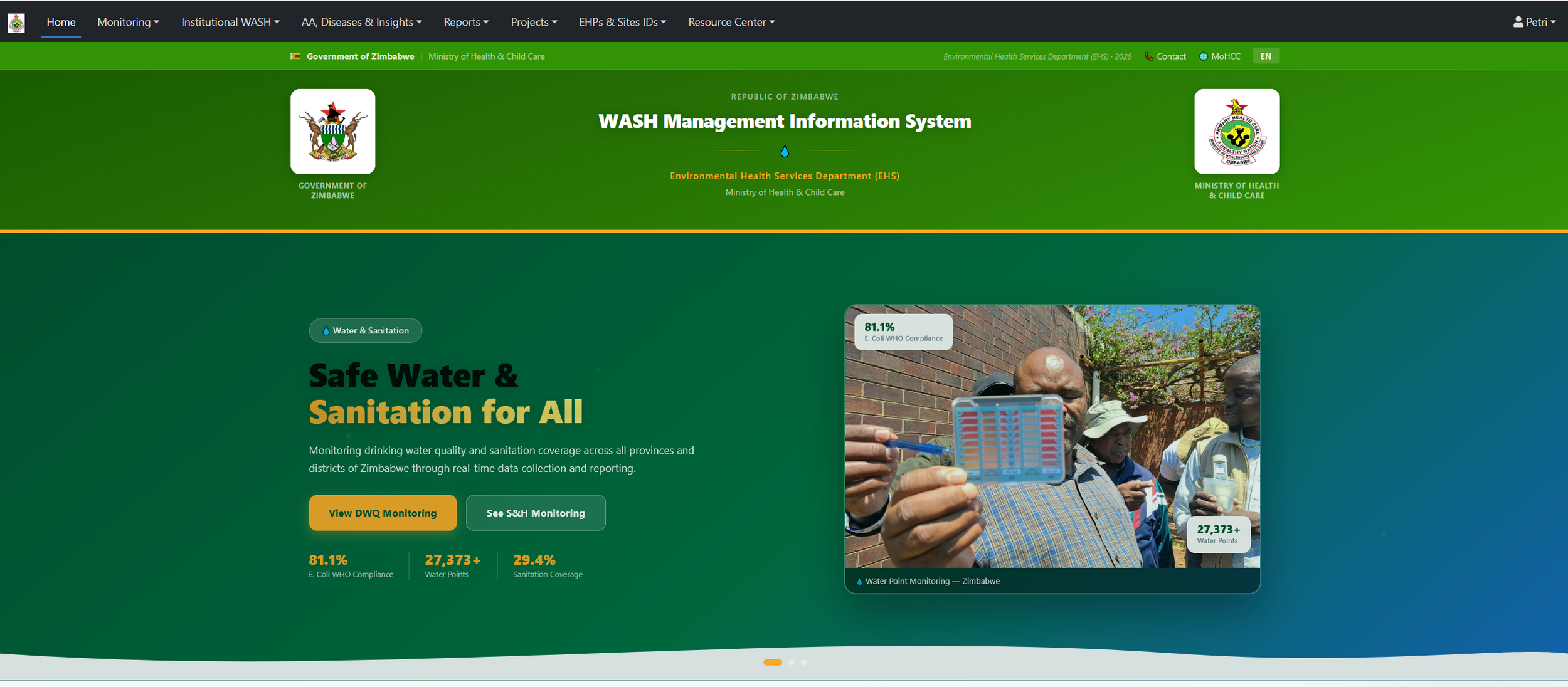
zimbabwemohcc.mwater.co homepage, October 2026
Partner: Ministry of Health and Child Care (MoHCC), Environmental Health Services Department
Country: Zimbabwe
Scale: More than 23,800 water points
Covers: Drinking water point safety, household and community sanitation, WASH-FIT in health facilities
Delivery: Fully virtual
Live since: March 2026
Public portal: zimbabwemohcc.mwater.co
The challenge
A national management information system, or MIS, can launch, meet initial requirements, and still fail. It fails when the government does not actually use it, or when it does not outlast the contract behind it.
The team in Zimbabwe initially used an Excel sheet, which helped them start collecting data but was not enough. Milliton Chivasa, Manager for Water, Sanitation & Hygiene at Zimbabwe’s Ministry of Health and Child Care, said the hard part of many MIS projects is keeping the system current as needs change daily, and keeping control of it. He added that most of the places the ministry monitors are rural, where mWater works particularly well.
Zimbabwe had a history with mWater before the MIS. More than 6,000 people have used mWater in Zimbabwe since 2020. Before the MIS was built and adopted, government staff had collected tens of thousands of data points on mWater without our involvement.
What the ministry built
The Zimbabwe MoHCC WASH MIS is a national monitoring platform that the Environmental Health Services Department runs directly. It is public at zimbabwemohcc.mwater.co and runs on mWater’s Light Blue product. It tracks the safety of drinking water points, household and community sanitation coverage, and WASH-FIT compliance in health facilities. The platform now holds more than 23,800 water points, all from district field submissions rather than one-off surveys, using indicators aligned with Sustainable Development Goal 6.
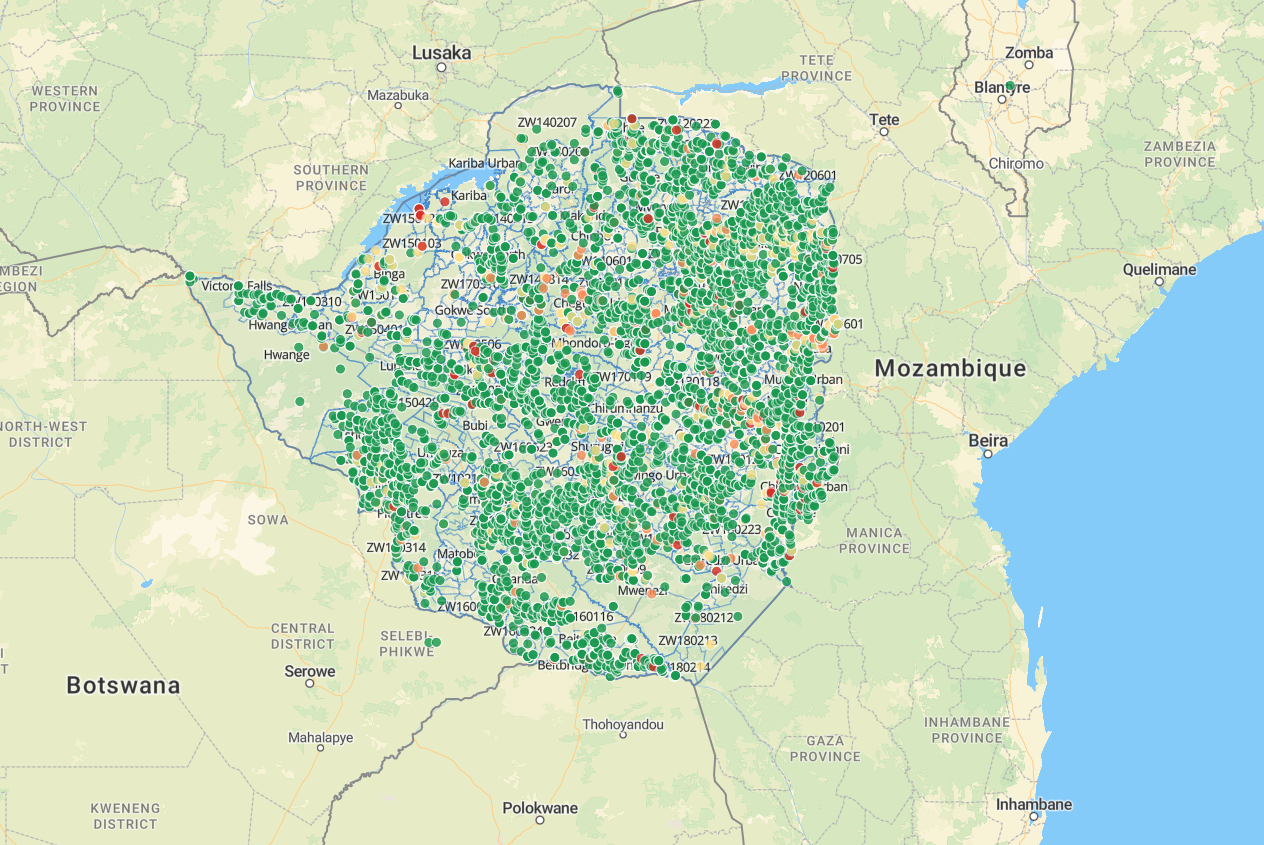
The platform keeps policy next to the data. Its resources library holds government documents such as the National Sanitation and Hygiene Policy, the ODF Roadmap, and the National AI Strategy. The Disease Trends console shows WASH-related diseases, including diarrhea, cholera, and typhoid, by month from January 2024. Users can filter it by province, district, and health facility.
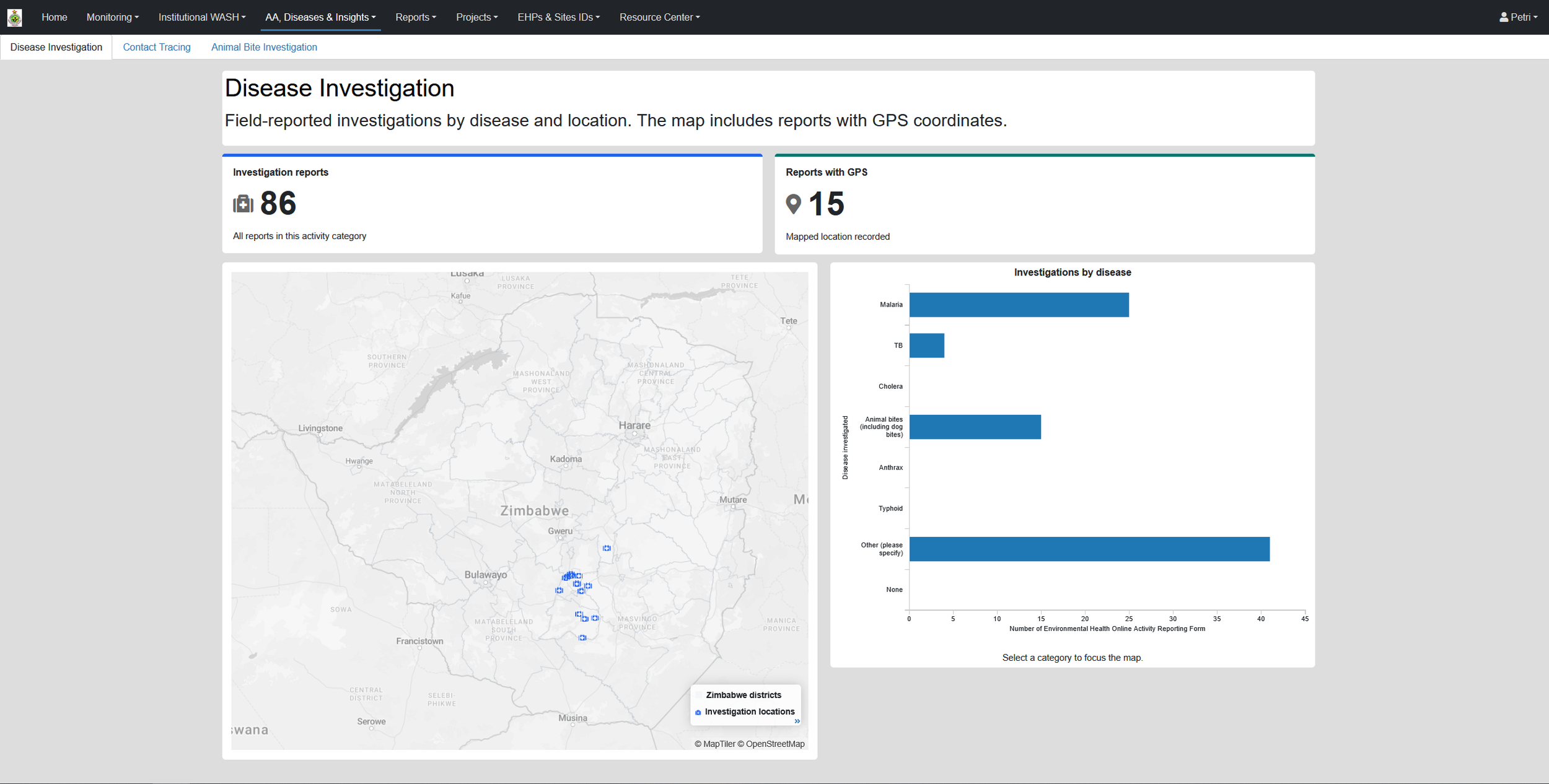
Disease investigation example
Built by ministry staff
Ministry staff is in charge of what gets built, and they did not need to wait for mWater to build everything. For the Disease Trends work, Milliton and Admire Masaga, a Public Health Specialist at the Ministry, used the mWater Integrator to build and clean the data pipeline themselves. They pulled health facility codes from DHIS2 and matched them to the codes in the master table. Admire is also building dashboards.
How we worked together
We worked with the ministry directly, not through an intermediary. In Zimbabwe, the subdomain, the branding, and the mandate belong to the ministry. Milliton, our main counterpart, uses the data himself, so requests come straight from the people who use the system.
We did all of this work virtually, with no international trips, no formal inception workshops, and no per diem costs. The portal is built on mWater’s tech stack including the well-tested data structures, user management, operational scalability, and top-tier data security, and is able to also use modular custom HTML and CSS blocks, so we could deliver requested features without a heavy development cycle. When Zimbabwe launched its National Health Strategy 2026–2030, we realigned the site’s mission statement to it within days. Priorities come from the ministry as its needs change instead of a scope fixed in a contract.
Milliton said mWater’s flexibility was a key reason the ministry can work on its own. His team can create and control its own surveys, track specific projects, filter data, and act on its data right away.
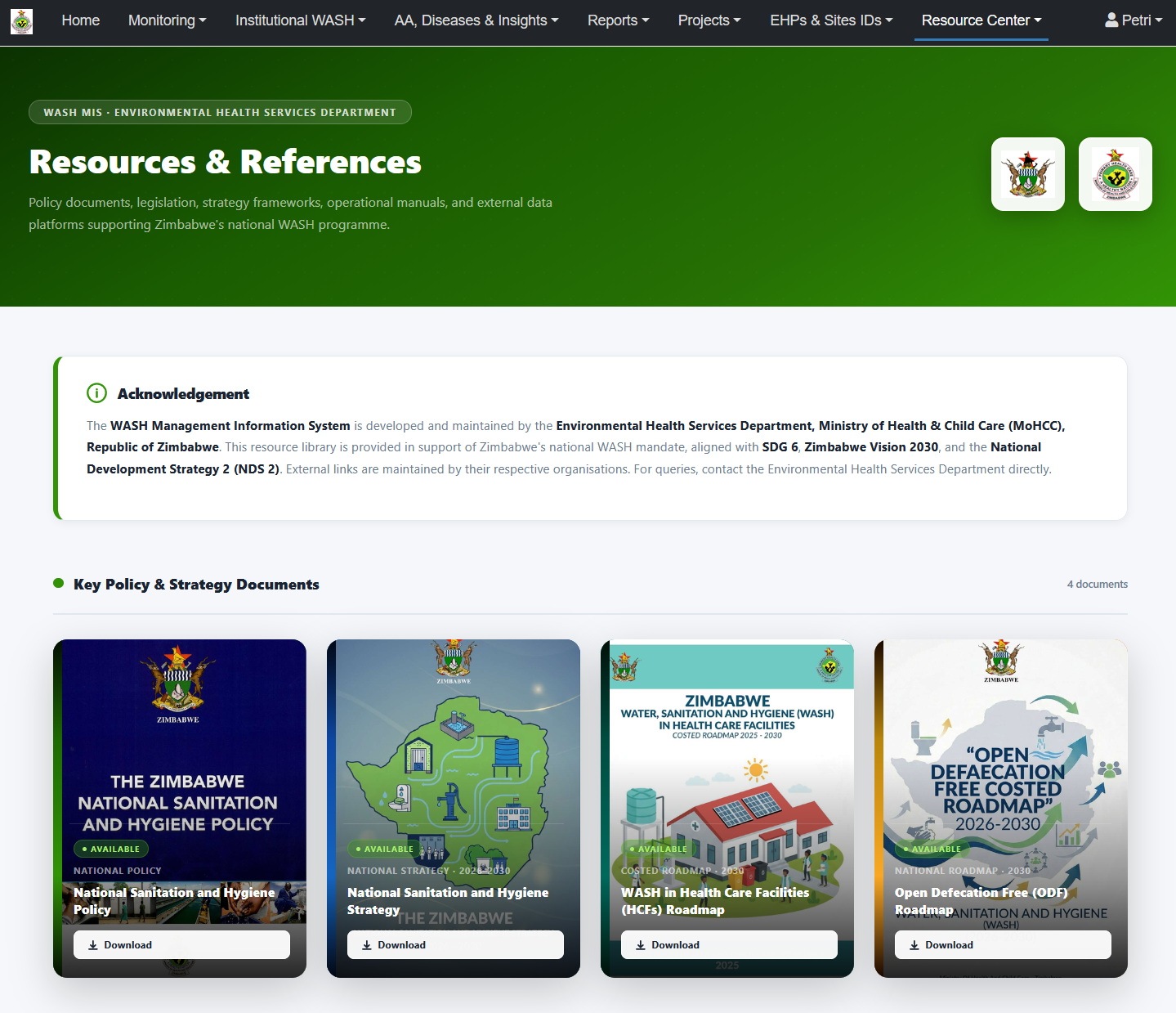
The Resource Center of the MIS
The MIS sits inside Zimbabwe’s own frameworks, including the National Health Strategy 2026–2030, National Development Strategy 2, Vision 2030, and SDG 6.
Results so far
The ministry showed the portal in public at the Africa Public Service Week exhibition, held June 20 to 24, 2026. Use is also spreading beyond WASH. Health inspection and disease investigation work can also run in mWater. Staff now keep a daily diary of their work, and the ministry aims to replace monthly reports with daily summaries that add up at the end of the month.
“mWater is one of the best MIS platforms
a ministry can have.”
What’s next
Milliton’s main advice to other governments is to plan for maintenance and train people to do it. He also advised using the MIS across several areas of government, not only WASH. Milliton’s own account gives reason for optimism: he describes a capable team, growing use across the department, and a platform the ministry controls.
About mWater
mWater provides digital public infrastructure for managing water, sanitation and hygiene data across the world. As of October 2026, there are about 395,000 registered users, 8,100 organizations, 8.1 million sites and 53 million survey responses. For work beyond SDG 6, see our sister platform Solstice: https://solstice.world.
Working on a national MIS? See national water monitoring for governments or contact us.
Learn more: branded program websites · giving districts access to their own WASH data