
Sanitation Asset Standard
Why create an asset standard for sanitation?
A pit latrine, a vacuum truck, and a sewer main are all sanitation assets. Data about them usually sit in separate surveys, spreadsheets, and reports that cannot be compared or combined. Open standards are one way to close that gap, and mWater has built them alongside our open-access digital platform.
The benefits of standardization include:
Simplified data management across users, regions, and system types;
Reduced switching costs when changing software vendors or platforms because the standard is open and belongs to no single platform; and
Increased adoption of data management best practices, contributing to the professionalization of sanitation service providers.
In 2022 we published the global Water Asset Standard, and since then mWater users have since mapped nearly 1.1 million water assets! Building on that success, we are publishing a global Sanitation Asset Standard. It gives practitioners such as service providers, government regulators, and development partners a common language for sanitation assets, so that data can be collected once, understood consistently, and reused across tools and institutions.
How we built it
We began the Sanitation Asset Standard in 2024 under the USAID IUWASH Tangguh project. Work stopped in early 2025 when USAID funding ended, but users and partners kept sharing the need for a global standard with us. Some users even creatively used water assets to map their sanitation systems in mWater. The sanitation asset standards that did exist were regional in scope, proprietary or tied to one platform, or written for sewered systems only. In 2026, we self-funded the work to build a standard that is global, open, and covers both sewered and on-site sanitation.
We started with a review of the sanitation literature, gathering existing publications and data schemas so the standard would use vocabulary the sector already knows. The Water Asset Standard is familiar to many of those users, so we mirrored its fields wherever water and sanitation assets are the same, such as pumps and pipes. As sanitation practices differ widely by region, organization, and technology, we created AI user personas and directed each one to work through the standard for its own assigned context, to ensure one standard could serve all of them. With version 1.0 of the standard published, we invite users to try out the standard, so that we can validate it against real records. If you would like to share your sanitation data with us to align it with the standard and assess it as part of our validation process, please reach out at info@mwater.co.
Standard structure
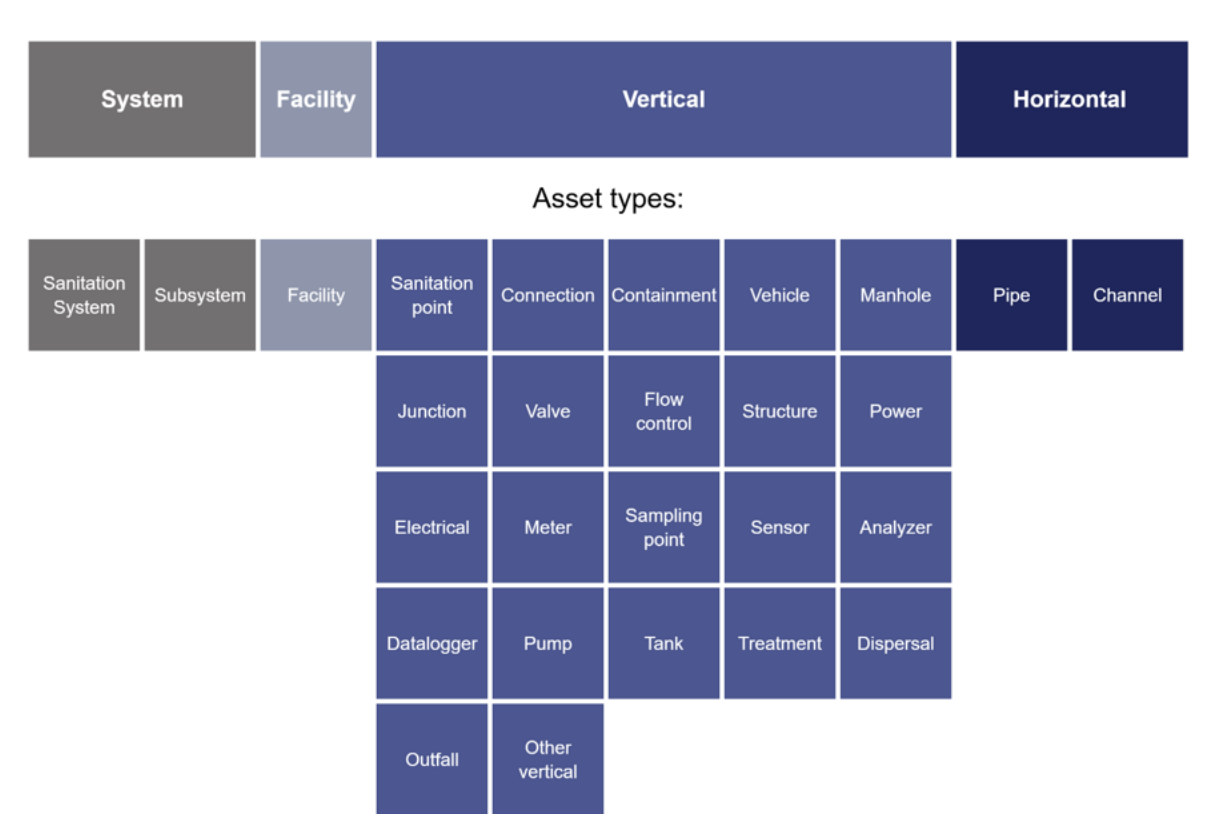
The figure below shows the structure of the standard with 27 asset types and 211 attributes in version 1.0.
Image 1. Sanitation asset classes and types
The standard covers both sewered and on-site sanitation, so an operator of a decentralized treatment plant serving a single neighborhood, a container-based sanitation manager, and a mid-size sewer operator can all use the same standard.
We chose the word "sanitation" for this standard because it covers assets that manage both wastewater and fecal sludge. "Wastewater," while a term more common outside of development contexts, would by definition leave out assets for fecal sludge management such as a pit latrine or a vacuum truck.
Image 2. All 3 of these example system types were mapped using the standard, demonstrating its ability to serve users from across the sanitation sector.
As with the water standard, no asset type or attribute is required, so users can take only the parts they need. Conditions narrow the fields further, showing only what applies to a given asset. Parent-child relationships sit at the center of the design, reflecting the reality of nested infrastructure where a pump belongs to a station, and a station to a system. Notably, the standard covers the management of assets but not operational activities. For example, it records a vacuum truck and its capacity, but not its daily collection route. However, in mWater, these operational data can be easily linked to asset data via Surveys, Workflows, Integrations with other platforms, and features for Customer Management, Meter Reading, and Accounting.
The full standard can be found here.
How to use it
The standard is open and does not depend on any one platform. We designed it for low-resource and operational settings, and it can be implemented in spreadsheets, GIS platforms, online databases, and mobile applications.
Within mWater, users can apply the standard in several ways:
Map the assets in the field using the mWater Surveyor app (Android, iOS)
Import or map the assets using the mWater Portal page for Sanitation Assets
Use the mWater MCP, our Model Context Protocol server, to align existing data with the new standard and add it to mWater with the help of AI
Read our full guide on using sanitation assets.
Image 3. Example workflow in aligning existing asset data with the new standard, using mWater’s Model Context Protocol (MCP)
___________________________________________________________________________________
The standard is distributed by mWater Foundation under the Creative Commons Attribution-ShareAlike 4.0 International License. A suggested citation for the standard is:
mWater Foundation. 2026. The Sanitation System Management Standard: Part 1 - Asset Management. Version 1.0.